Modeling the Early Earth: Idealization and Its Aims
By Junjie Dong / October 27, 2026 / CC BY-SA 4.0 / doi:10.5281/zenodo.23876214
Originally published on the EGU Geodynamics Blog, July 10, 2024.
The Early Earth Questions
In my graduate school, one of the most popular reading groups in the department focused on the early Earth, discussing questions such as the initiation of plate tectonics, the origins of the dynamo, and more. As a young graduate student, I was both excited and intimidated to partake in these weekly discussions with people like Nadja Drabon, Roger Fu, Andy Knoll, and Charlie Langmuir. I felt like a young puppy among seasoned dogs—curious and eager, but prone to the missteps typical of a novice. I vividly remember the aftermath of each heated discussion: I would leave either dejected, convinced that the questions about the early Earth were unsolvable due to the paucity of rock samples and their biased interpretations, or elated, believing that we could solve them by trusting a few select geological proxies and their idiosyncratic interpretations. These extremes of emotion were fleeting, quickly overshadowed by new evidence and arguments the following week.
The approach to these early Earth questions was foreign to me at first. In my field of mineral physics, we rely heavily on strong empirical evidence. For example, we measure the sound velocity of a mineral and compare it to seismic velocities to infer the composition of the mantle (Anderson 1972). The challenges in mineral physics are often technical, rooted in our ability to obtain reliable data (Fei & Walter 2022), which made me an empiricist by necessity. In contrast, to explore the early Earth, one often has to work with under-constrained theoretical models and sometimes even metaphysical thought experiments due to the sparse and highly weathered rock record. Terms like “theoretical” and “metaphysical” may seem “unscientific” to some, but I do not share this Popperian skepticism [1]. On the contrary, I find these theoretical exercises profoundly fruitful. By idealizing the early Earth in often simple theoretical models, we gain access to its nature and a path to deeper understanding.
Here, rather than trying to comment on the specifics of geodynamic modeling practice, I would like to consider a less explored angle: how we idealize the early Earth in modeling, and what these exercises teach us. I will now use an example from my own work to illustrate the heuristic value of early Earth models. My views are certainly rudimentary, but the goal is to get the reader thinking about the methodology of modeling the early Earth.
Archean Earth Was a Water World
In my 2021 paper published in AGU Advances, we estimated the size of the surface ocean in the Archean using a mantle water storage capacity argument (details of which can be found in Dong et al. 2021). We found that the Archean oceans might have been up to twice as large as the present-day ocean (Figure 1). This naturally led us to wonder how a larger early ocean might have altered the configuration of the Earth's surface, potentially resulting in a landscape drastically different from today's Earth.
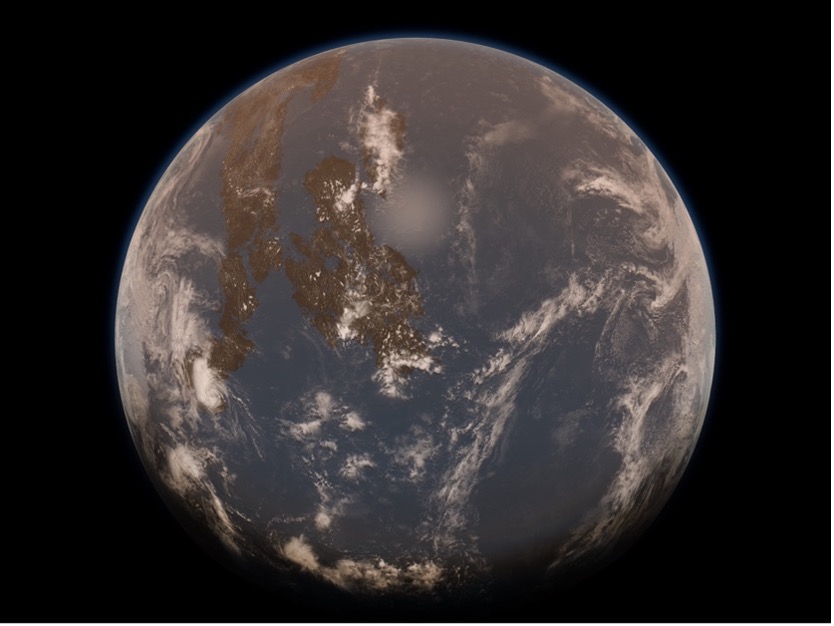 |
Figure 1. An artist's impression of the early Archean Earth, with minimal landmasses and a global ocean. Image credit: Alec Brenner.
For those working on the classic post-glacial sea level problem, modeling Archean sea level may seem like an impossible task. Accurately modeling post-glacial sea-level change requires knowledge of glacier dynamics, the Earth's gravitational field, and how the Earth deforms under loading and unloading, combined with detailed oceanographic, meteorological, and coastline records (Mitrovica et al. 2011), about which we know almost nothing for the early Earth. However, post-glacial rebound research aims to understand changes to the accuracy of meters in order to understand sea level response over much shorter time scales. Our goal was different. We were not looking for the exact sea level, which is extremely difficult to estimate even for the Proterozoic and virtually unattainable for the early Earth. Instead, we were only interested in the relative configuration of mountains and seas and, ultimately, whether the early continents were flooded with water—critical to understanding the origin of life and the physical conditions that supported it.
In seeking a simple model to describe the solid Earth's influence on sea level change over billions of years, we settled on a continental freeboard model based on isostatic balance, constructed by Flament et al. (2008) and later improved by Korenaga et al. (2017) and Rosas & Korenaga (2021). The isostatic model is used to relate the densities and thicknesses of different layers of the Earth's surface to the sea level, including continental crust, oceanic crust, lithospheric mantle, and asthenospheric mantle (Figure 2).
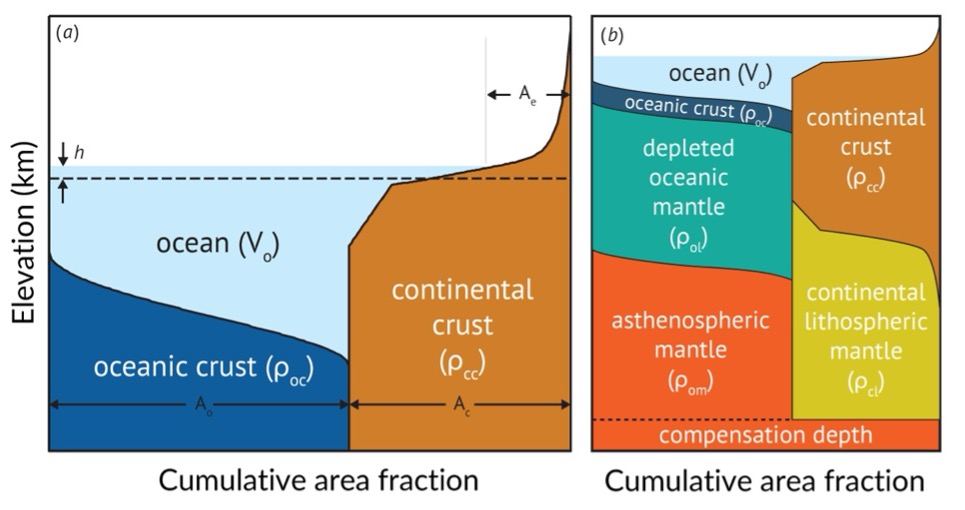 |
Figure 2. Schematic of continental freeboard modeling of the Archean Earth. Figure adapted from Korenaga et al. (2017).
Our findings (Dong et al. 2021, Figure 3) suggest that if the early oceans were more than twice their current volume, the continents were likely covered entirely by water, with only a few subaerial landmasses from hotspot volcanism or oceanic plateaus. If the early ocean was 1–2 times the present-day volume, the continents would still be largely flooded. With a fixed ocean volume, increasing the size of the early continental crust or decreasing its topography increases the flooded fraction.
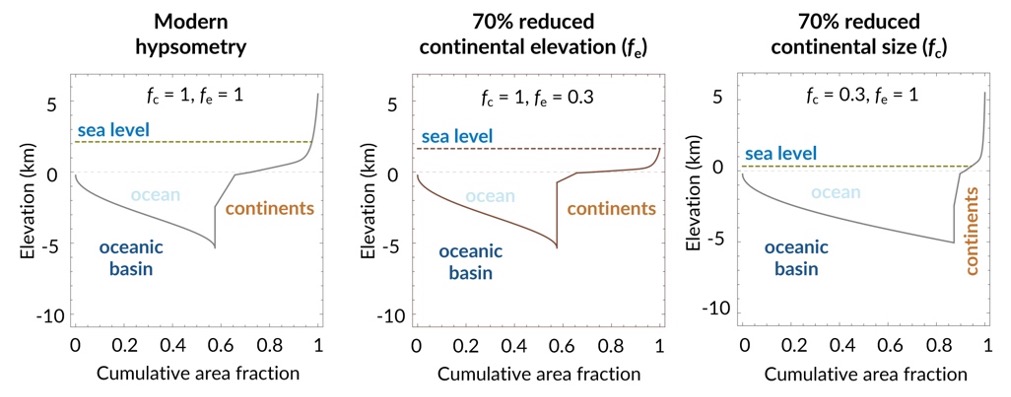 |
Figure 3. Flooding of the Archean Earth with various surface configurations; figures based on the results of Dong et al. (2021). Abbreviation: fc: fraction of the present-day continents; fe: fraction of the present-day elevation.
In this work, we sought to understand how the isostatic balance adjusts in response to a different ocean volume. While our work provides a new constraint for one parameter in the model—the ocean volume—the rest remains largely unconstrained. Extrapolating the isostasy model to the early Earth involves adjusting parameters such as the thermal and chemical buoyancy effects on the oceanic and continental lithosphere, as well as the hypsometric curve to reflect changes in emerging continental crust (Flament et al. 2008; Korenaga et al. 2017; Dong et al. 2021; Rosas & Korenaga 2021). We know practically nothing about the validity of these parameter choices, and our parameterization, at best, is educated guesses and might well be incorrect. So why is modeling the early Earth still a useful exercise?
The Kinds and Aims of Idealization
Before answering that question, let me first introduce some conceptual resources—two kinds of idealization that are widely discussed in the philosophy of science (Weisberg 2007): Minimalist Idealization and Galilean Idealization. Minimalist Idealization aims to identify and include only the primary causal factors responsible for the behavior of the idealized system, excluding unnecessary details. Using the aforementioned sea-level model as an example, one could consider an asymptotically hypothetical scenario in which there was no dichotomy in the early Earth's crust at all. Instead of having a lighter continental column and a denser oceanic column creating topographic relief that forms ocean basins, we imagine a uniform layer of mafic crust covering the Earth's surface. We quickly realized that not much water would be needed to flood the early Earth's surface. Unlike today, where water must fill ocean basins before reaching land, a thin layer of water could easily cover the Earth due to the lack of density contrast between oceanic and continental columns. This hypothetical scenario, while counterfactual, illustrates how little water might be needed to create a “water world” planet. It also shows that determining whether the surface of the early Earth is flooded with water involves balancing the amount of water on the surface with the topographic relief that the density contrast of the crust can support. I would consider this exercise to be profoundly heuristic; by applying this Minimalist Idealization, we can learn how the idealized system behaves when certain effects, such as the presence of continents, are removed. While we may not know if or when the early Earth had only a uniform mafic crust, such an exercise allows us to explore the effects of continents without the need for a disputable parameterization of the growth curve of the continental crust.
Of course, to make a problem computationally tractable, we then resort to the second type of idealization, Galilean Idealization (or Pragmatic Idealization), where we introduce deliberate distortion, or a more familiar term if you will, parameterization, into the model (Weisberg 2007). In this context, parameterization includes the temperature and density of the crust and the underlying mantle, the hypsometry of the continents, and the bathymetry of the ocean, etc. A more specific example would be to introduce distortion or parameterization to simplify the thermal evolution of the 3-dimensional heterogeneous interior of the Earth into a 0-dimensional curve of homogeneous temperature change as a function of time. Such Galilean Idealization, with its emphasis on pragmatic utility and completeness, contrasts with Minimalist Idealization, which focuses instead on explanatory power and the identification of causal factors. Here, the parameterization of the chemical buoyancy of crusts, the growth and topography of continents, and the shape of ocean basins fall into the realm of Galilean Idealization. Improved parameterization can certainly provide a more detailed representation of a particular early Earth scenario (Figure 3), but may not always provide a deeper understanding, especially in the face of a near-absence of geological evidence.
By making you endure this mental gymnastics, I hope to provide a framework to understand what kinds of idealizations (without regard for whether the surrounding assumptions are true) are employed in early Earth models and why they are useful. The cognitive role of Minimalist Idealization aids explanation by exploring how the idealized system behaves without the need for precise characterization (unlike Galilean Idealization).
How to Model the Early Earth
I would like to declare up front that no matter how much I enjoy championing idealization in modeling and why it helps us gain an understanding of the early Earth, I would still give priority to geological evidence and acknowledge how informative it can be as primary data. But the hard truth is that they are very, very difficult to find. Mark Harrison, in his recent book titled Hadean Earth (Harrison 2020), emphasizes the need for “systematic, mission-scale geochronology surveys” to create a comprehensive archive of early Earth rock samples [2]. While geologists tirelessly search for these early vestiges, we as theorists must continue to improve our models. I certainly do not have any well-formulated answers as to how, but I would like to break the ice and share three thoughts.
As computing power and techniques improve, so does our ability to refine the Galilean Idealization or parameterization. We now have complex models that couple Earth's interior dynamics with climate and biological evolution (Stern & Gerya 2023), aiming for a more accurate representation of the planet as a whole. These efforts can be thought of as de-idealization, reducing distortions in the idealization to make the parameterization more representative of the real world. However, this may not always bring us closer to reality. Instead, it could be viewed as multi-model idealization, the third kind proposed by Weisberg (2007), where several related models are patched together to represent the real world. While productive, we must ensure that the compatibility of different components of such complex models is not assumed without scrutiny.
Despite our desire for more geological records, the critical evidence needed to test a model may not come soon, if ever. Our shoulder devil insists that older rocks cannot be found and that the existing ones are too altered to be trusted, while our shoulder angel sees the presence (or absence) of certain geological records in a deterministic way, persuading us to go ahead and make the strongest propositions [3]. Many of us, including the young me every time I emerged from the Early Earth reading group, were torn between these two forces. After sharing my frustration with my friend Matthew Brewer, a philosophy of science graduate student, he wrote a paper on the subject! Brewer (2024) cautions against binary and reductionist thinking about the rock record, suggesting instead that we might simply take an agnostic approach to the limited geological evidence at our disposal as a scaffold for exploring auxiliary assumptions related to theories, models, or hypotheses. One could conditionally treat a hypothesis of geological evidence as true for the sake of later investigation of its auxiliaries. The specification of such auxiliaries allows for more informative contrastive testing of an initial hypothesis against alternatives, and in Brewer (2024)'s view, such a process would allow scientists to make real progress toward more refined theories that include a greater number of auxiliary hypotheses that more adequately describe the early Earth.
So, how open are we to different hypotheses of the early Earth? According to Mark Harrison, probably not very much, and I quote (Harrison 2020): “How much more would we know about the world today if the community had not rolled over and uncritically adopted […] paradigms […]? How many young scientists would have been inspired to pursue alternate explanations for lunar formation, or the origin of continental crust, or the lunar bombardment history had we not told them that these were solved problems?” I echo Mark Harrison's concern and his emphasis on avoiding groupthink in early Earth research and seriously considering the new and sometimes even unorthodox theories. It is crucial to return to the basics, to the nulls, to simple models, rather than emphasizing what Feyerabend calls the “Consistency Condition”—demanding new evidence and interpretations to be consistent with accepted theories (Feyerabend 1993). We must bear in mind that the ultimate goal here is not to preserve old understandings of the early Earth, but to find deeper and perhaps better ones. Only evidence and hypotheses that challenge well-established theories will provide the clues to early Earth questions that cannot be obtained otherwise.
Notes
[1] Popper proposed the so-called “Demarcation Problem”, in which one can distinguish between science and pseudoscience by falsifying hypotheses with critical evidence; a falsifiable hypothesis would be considered scientific (Popper 2002).
[2] This is not easy in practice; challenges include lack of funding, and more importantly, who gets to decide the interpretation of a rock record in the event of a dispute, etc.
[3] For example, the absence of blueschist and ophiolite before the Neoproterozoic is sometimes taken as evidence that plate tectonics was not operating then. See more details in Brewer (2024).
References
Anderson, O. L. 1972, Tectonophysics, 13, 521, doi:10.1016/0040-1951(72)90036-4
Brewer, M. 2024. philsci-archive.pitt.edu/23493
Dong, J., Fischer, R. A., Stixrude, L. P., & Lithgow-Bertelloni, C. R. 2021, AGU Adv., 2, e2020AV000323, doi:10.1029/2020AV000323
Fei, Y., & Walter, M. J., eds. 2022, Static and Dynamic High Pressure Mineral Physics, 1st edn. (Cambridge University Press), doi:10.1017/9781108806145
Feyerabend, P. 1993, Against Method, 3rd edn. (Verso)
Flament, N., Coltice, N., & Rey, P. F. 2008, Earth Planet. Sci. Lett., 275, 326, doi:10.1016/j.epsl.2008.08.029
Harrison, T. M. 2020, in Hadean Earth (Springer), 273–286, doi:10.1007/978-3-030-46687-9_12
Korenaga, J., Planavsky, N. J., & Evans, D. A. D. 2017, Phil. Trans. R. Soc. A, 375, 20150393, doi:10.1098/rsta.2015.0393
Mitrovica, J. X., Gomez, N., Morrow, E., et al. 2011, Geophys. J. Int., 187, 729, doi:10.1111/j.1365-246X.2011.05090.x
Popper, K. R. 2002, Conjectures and Refutations: The Growth of Scientific Knowledge (Routledge)
Rosas, J. C., & Korenaga, J. 2021, Nat. Geosci., 14, 51, doi:10.1038/s41561-020-00673-1
Stern, R. J., & Gerya, T. V. 2023, in Dynamics of Plate Tectonics and Mantle Convection (Elsevier), 295–319, doi:10.1016/B978-0-323-85733-8.00013-5
Weisberg, M. 2007, J. Philos., 104, 639, doi:10.5840/jphil20071041240