My First Field Trip with the Geology Club
By Junjie Dong / October 30, 2026 / CC BY-SA 4.0
This was my first field trip with the Geology Club since I joined the department. I also took on the role of faculty co-advisor with Bill. On October 17, 2026, we spent half a day at the American Museum of Natural History, mostly in the mineral hall. What inspired me most was the club members themselves. Not all of them are geology majors, but all of them have a deep passion for minerals and rocks.
The club has a capable E-Board: Ophelia, Kristen, Laila, and Andrew, who made the trip possible even in the face of chaotic weekend train construction and transfers.
My research is in mineral physics. The minerals I work with in the lab do not look much like the specimens in the mineral hall. They are mostly light-colored powders in samples too tiny to admire. Or, in molecular dynamics simulations, they are typically no more than a few hundred atoms, elegant in their own ways, but without glitter. So, walking into a hall of minerals in every shape and color, made of as many elements as you can think of, was a reminder to me of how much is out there for mineralogy.
The mineral collections are traditionally arranged by crystal chemistry. Now, the refurbished display adds the story of mineral evolution introduced by Bob Hazen. It begins with the simplest building blocks and moves to more strange, exotic, and complex ones. It prompted me to think about how we have come to understand minerals conceptually: we move from the chemical view of simple systems to complex ones. Then, we build an epistemological atlas of what they mean for the origin, history, and evolution of our planet and solar system.
It is fascinating to think about the minerals that mineral physicists are obsessed with. Olivine and bridgmanite in the mantle, and iron metal in the core, are really just a small portion of mineralogy, even though they make up most of the interior of the Earth. Their chemistry is constrained to be relatively simple by the enormous pressure. Near the surface (also where we dwell, ephemerally compared to the geological timescales that formed them), without that constraint, the same palette of elements branches out into a pantheon of minerals in different electron environments.
The minerals that make up most of the planet are so few in kind, while the many kinds near the surface combined are only a rounding error in its mass. As someone who spends most of my time with powders and atoms, it was a gift to spend a day with one of the great mineral collections, as well as the people who love them.
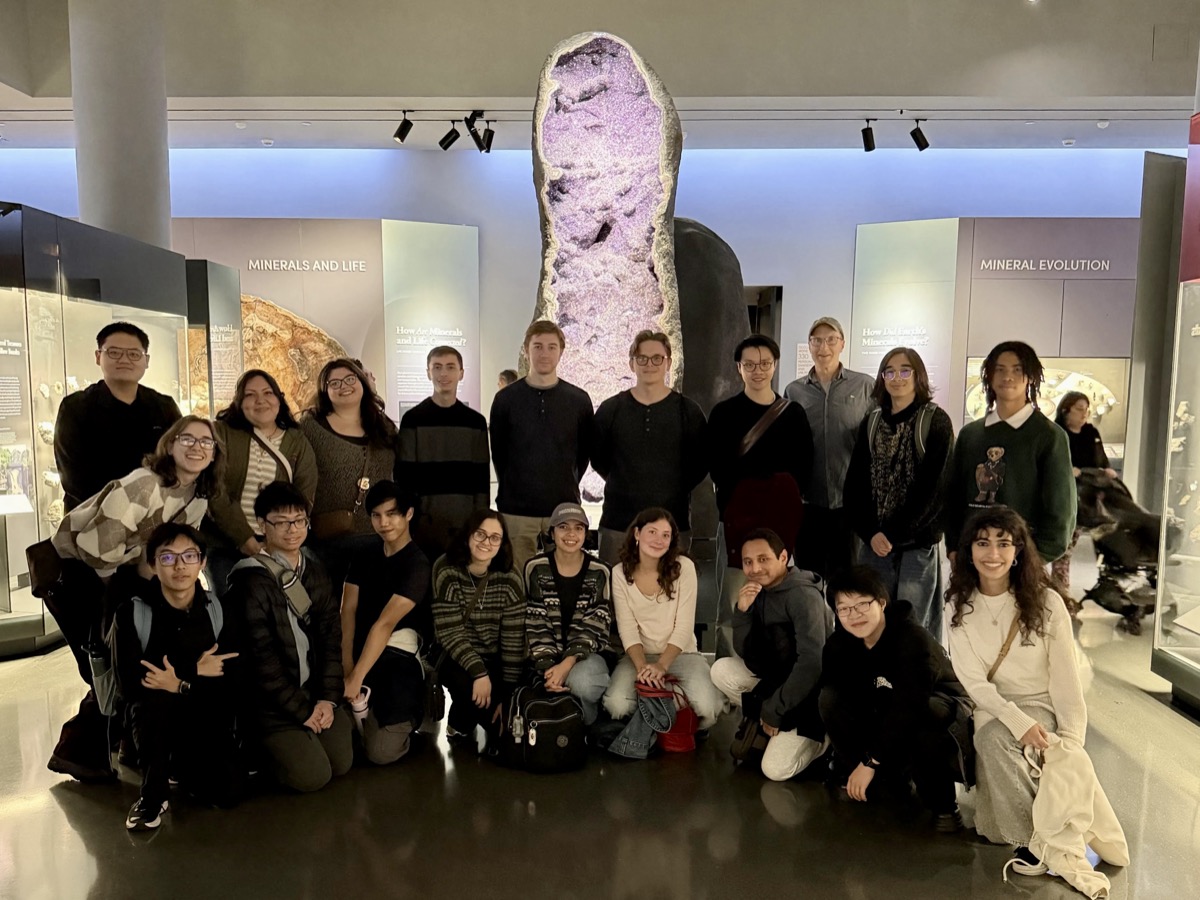 |
Figure 1. The Geology Club members in front of the giant amethyst geode from Uruguay in the Halls of Gems and Minerals.